We arrived in Wadi Halfa around midnight, a full day’s travel and a historical detour behind us. Our pace had slowed as the hours went on, the highway lit only by our headlights had grown more serpentine.
Yet we were surprised to find that Hamu, with whom we would be staying, was not only still awake, he was ready to greet us with a Sudanese dinner. He now working as a shipping agent on the newly opened border post between Egypt and Sudan, I knew his brother living in the US. He and his brother generously opened their home to us.
The next morning, we woke up to the sound of the children of the house laughing as they headed off to kindergarten, wearing their backpacks. From Jakarta to Juba, seeing children heading to school is always a good sign, giving hope that society has its priorities in order and is preparing for a brighter day ahead. Maybe the next generation will overcome our many failings. I was carrying a guava from the tree in my father’s house that I intended to plant in Halfa. But the girl’s laughter was too charming and I gave it to her.
As they headed off my thoughts turned not to the future but to the ancient past. I came to experience the place of my grandfather’s birth, and his grandfather, and his; that part of our identity that I referred to as “Halfawi,” or “from Halfa” even though I could never set foot in that submerged village that was evacuated two years before my birth. Having met the neighbors that were relocated to New Halfa, and having walked through the house my father was allocated, this visit could only be about understanding the story of the flood from those who had refused to emigrate.
On the other hand, my mother’s side of the family came from a village some 120 kilometers to the south; a village called Sarkametto just beyond the reach of Lake Nubia. We had passed it during the night but it was too dark to notice. After visiting the city center, our plan was also to visit there, to search from at least some traces of my ancestors above the water line.
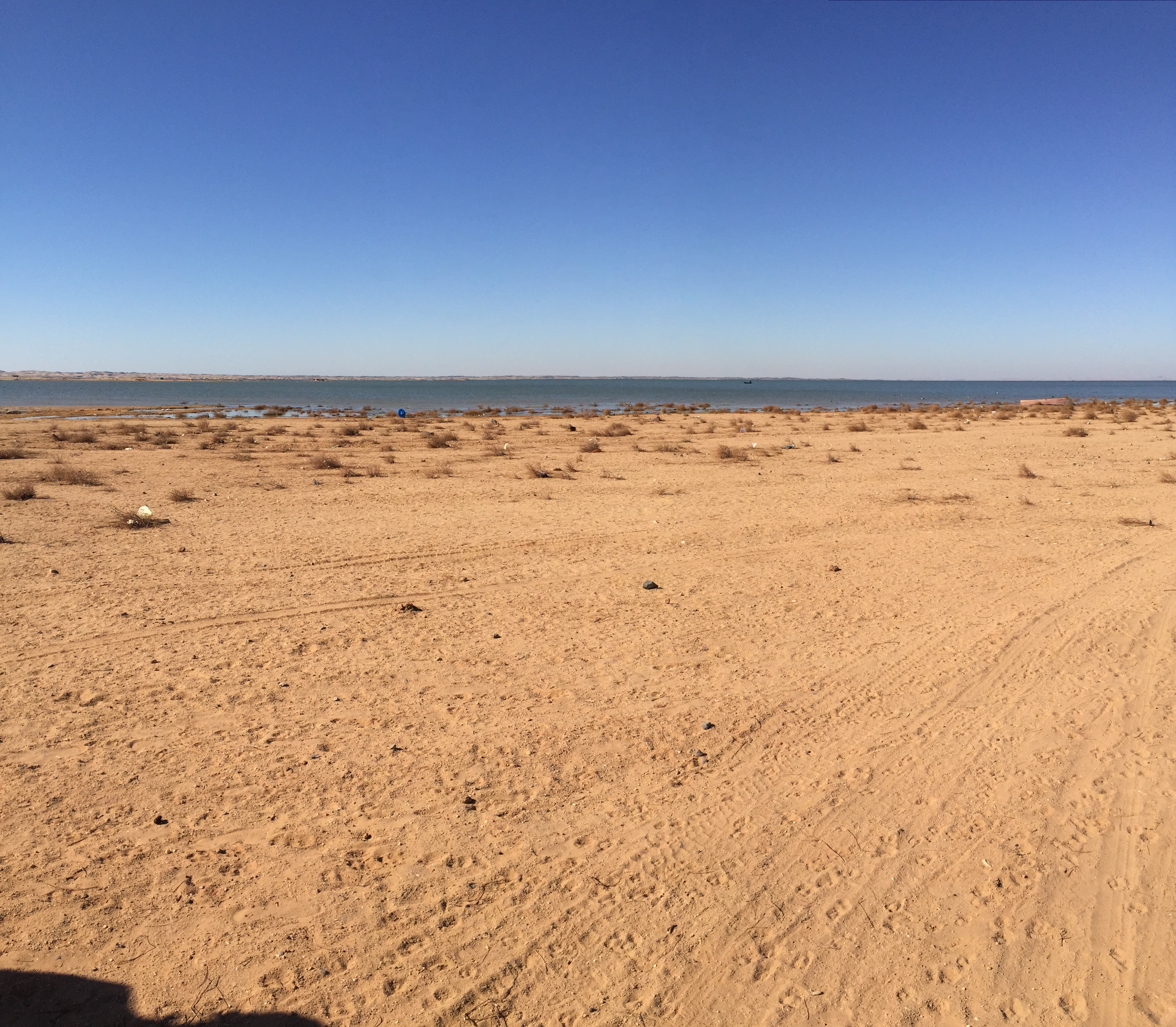
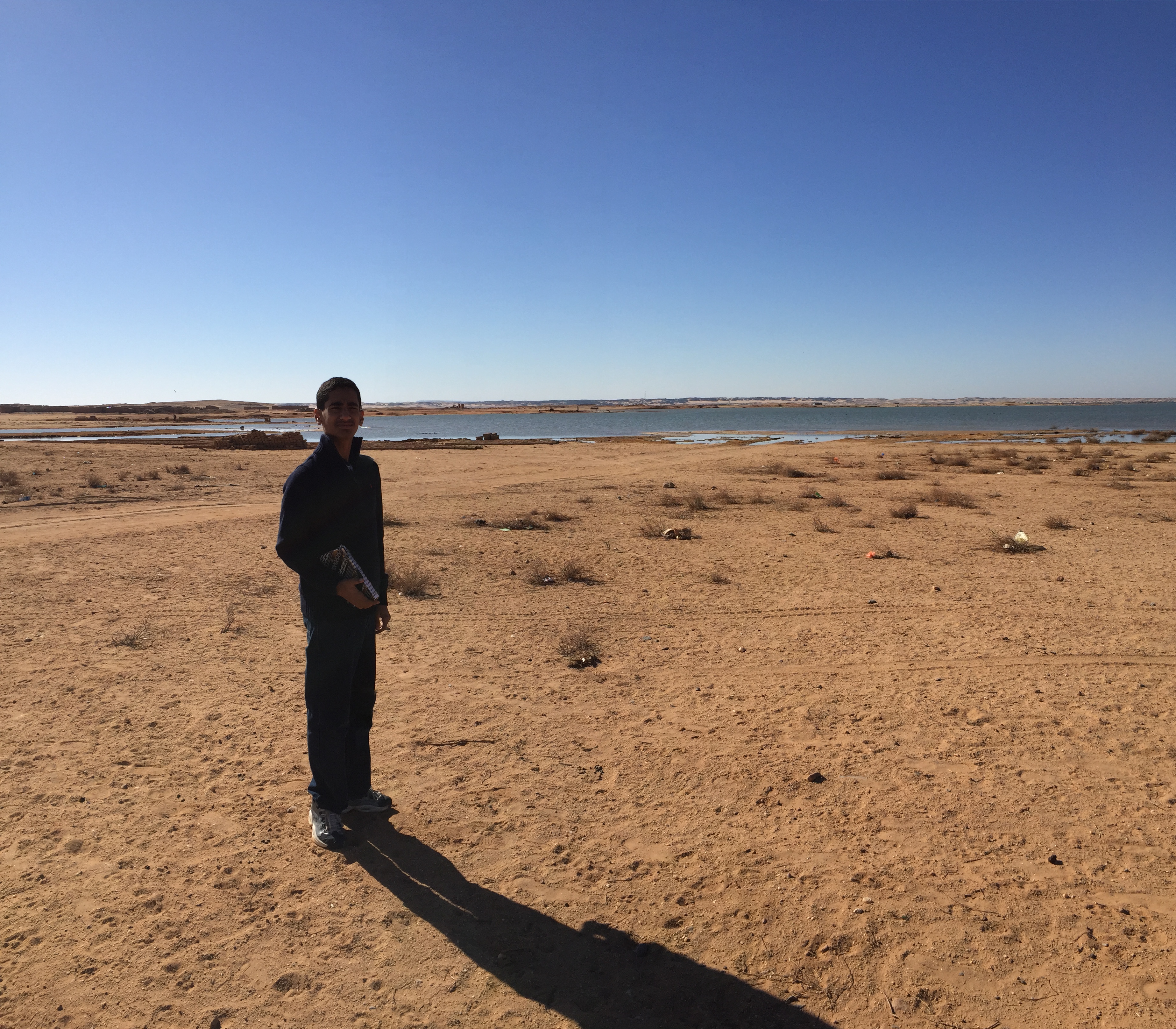
As we drove to the city center, Hamu pointed to the Lake at approximately the location of the villages on my father’s side were located. There is no village; we only looked out at a vast expanse of water more like a sea, with some sparse vegetation growing at its banks.
I asked to step out of the car.
As we walked to the water’s edge, Tariq and I looked out over the horizon and tried to imagine the villages in the valley below, teeming with life. We were greeted by silence, except for small waves lapping up to the shoreline, and the sound of wind. The water looked dark; impenetrable; cold. This proud river, the world’s longest, was not going to easily forgive us for turning it from the source of life to a source of dislocation. I felt compelled to offer a small prayer, recognizing the countless generations of deceased in the cemeteries below who, unlike the living, could not board the trains to higher ground. These prayers could not penetrate but rather skipped along the surface like stones thrown by a father and son. It was a feeling not of closure but of distance. Too little, too late.
Fifty years too late to see the Wadi Halfa in its prime, as one of the most beautiful cities in Sudan. In ancient times it was a trading city; the southern extension of the navigable stretch of the Nile that led to Aswan. In modern times it was served by a train station to Khartoum and a steamer that would link it to Abu Simbel, only 70 kilometers to the north, and Aswan further downstream. During the British conquest of Sudan, avenging the death of Charles Gordon, Wadi Halfa was the headquarters of the army of Lord Kitchener who had brought with him a war correspondent named Winston Churchill.
During World War II the allies used Wadi Halfa was a communication post. The British had built a railway in the 19th century that linked the country to Sudan. Wadi Halfa was the economic and administrative center of the region between the first and second cataracts. It contained tree-lined boulevards and the beautiful Nile Hotel that housed famous visitors throughout its history including a stream of dignitaries and royalty who supported efforts to salvage and document its history before the flood.
Our plan was to find Nubians, older than fifty, who had refused to be relocated to New Halfa and had experienced life over the last 50 years in Nubia itself. They could convey to us what life was like and how they coped as Lake Nasser, called Lake Nubia in Sudan, filled up. As the water line rose and pushed them back; these Nubians picked up their homes and rebuilt them, as well as the town itself, further back away from the rising waters. They did this several times, as the Lake did not stabilize until the early 1970s, nearly a decade after the trains took the majority away.
Downtown, we found three of them; Sawi Mohamedi Biteik, a retired educator, Yunis Mohamed Abdel Majid, President, Cooperative Union of Farmers, and Faisal Hussein Abdel Latif. After walking around and seeing the present day town, very much a market that supported the new found gold wealth in the region, and the ferry that left every few days to Aswan, and now an increasing border trade with Egypt.
We sat down to a breakfast of fish, caught from the Nile, and fresh bread, and listened to their stories. Like the residents of New Halfa, they bore the resentment of neglect and marginalization. They first offered me a history lesson.
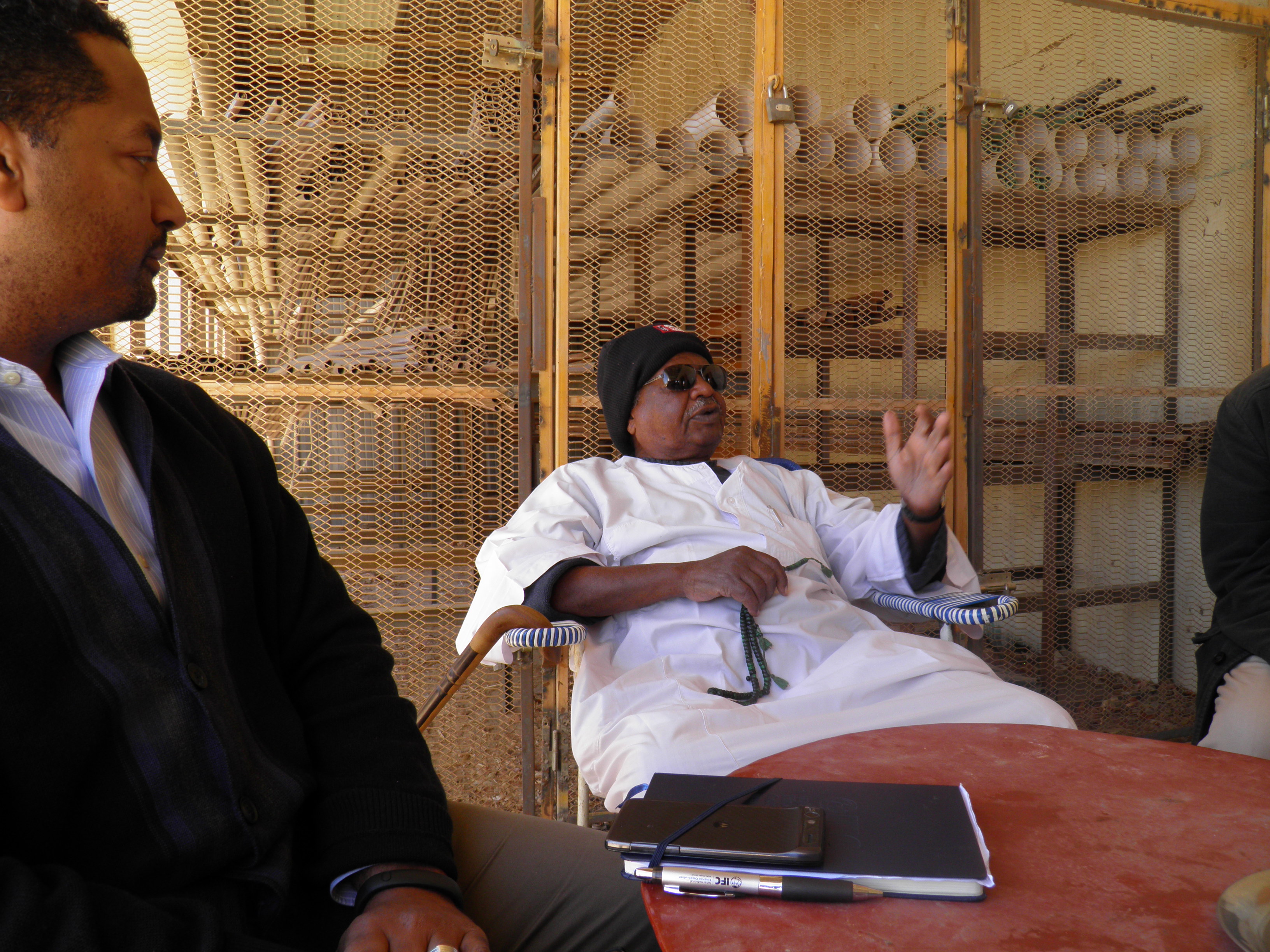
They explained that the Sudan was completely unprepared for the negotiations with Egypt, and for this reason the compensation and resettlement efforts were completely inadequate.
In the 1950s, Egyptian President Gamal Abdel Nasser had made the High Dam a symbol of sovereignty and independence of Egypt, and a key part of his bid for leadership of the Arab world. After the West refused to finance the dam, Nasser used this as a pretext to nationalize the Suez in order to generate the necessary funds. After the ensuing Suez crisis, Nasser aligned himself with Kruschev who offered to finance and build the High Dam.
Implementing the High Dam would require that the Nile Waters agreement between Egypt and Sudan, in place since 1929, to be renegotiated. Discussions with Sudan had taken place in 1952 that were inconclusive, as Sudanese negotiators were wary of continuing a very one-sided deal.
At the same time, Egypt was negotiating both with the British and Sudan over Sudan’s self-rule. Egypt conceded the principal of Sudan’s right to self-determination in its discussion with Britain. The agreement on self-rule called for a three-year transitional period, after which Sudan would decide either for unity with Egypt or for independence. Egypt was confident Sudan would opt for, as King Farouk had touted, “unity of the Nile Valley.” In fact, 1953 Parliamentary elections resulted in the party favoring union with Egypt winning 51 out of 97 seats. The Nationalist party that favored independence on won 20 parliamentary seats.
This made it likely that Sudan would vote for unity after the transition period. But not wanting to take any risks, Egypt deployed Major Salah Salim, a member of Nasser’s Revolutionary Command Council, as a senior liaison with the Sudan. He went on a campaign to influence the outcome of Sudan’s decision in favor of unity. His campaign in the north included radio transmissions from Cairo to Sudan which constantly tried to persuade the Sudanese.
On a trip to Southern Sudan, he spread cash and made numerous promises in order to win the favor of the southerners. When he was greeted with a traditional Dinka tribal dance, in which the men dance nearly nude, Salah Salim shed his cloths and joined them. Salah Salim was interfering in the Sudan while at the same time presenting Egypt’s foreign policy as one that favors non-alignment and non-interference.
His campaign of interference ultimately backfired. The position of the Unionists, who had won the upper hand in Sudanese Parliamentary elections, was undermined. The Prime Minister Ismail al-Azhari, whose career and ideology was built on a strong relationship with Egypt, recognized the popular discontent with unity with Egypt and called for full independence. Thus January 1, 1956, Sudan became the first newly independent country in Africa – independent of both Egypt and Britain. The nationalist party took power, led by Umma (Nationalist) politician Abdullah Khalil.
Independence did not solve every problem. Between 1956 and 1958, Sudanese leaders from both major parties sought to find solutions to the intractable problems of building a new nation. The task of forming a constitution was difficult. Al-Azhari, the first Prime Minister, made little progress. Khalil, the Umma party leader and second Prime Minister, also failed to overcome the country’s economic, political and security weaknesses. Khalil allied himself with the United States, which immediately drew the enmity of Nasser and Egypt.
By November 1958 the situation had reached a boiling point. The military led a coup d’état on 16 November 1958, to end, in the words of the Commander in Chief, “the state of degeneration, chaos, and instability of the country.” With those words, Sudan’s first experience with democracy came to an end. The third leader took power. The country was not yet three years old.
This leader’s name was Abboud. Two years later he would be invited by President Kennedy for a state visit to the White House and a tour of New York, Chicago and Los Angeles. My father was dispatched from his job representing Sudan in UNESCO to help prepare this visit, which is why I was born in the US.
As a military man, Abboud had great admiration for Nasser, and was ready to reopen negotiations on the Nile Waters Agreement almost immediately. By many accounts, he had improved Sudan’s position in the agreement, which was reached in less than a year.
But he was completely not prepared for an accurate estimate of what should be requested to compensate Sudan for the loss of Nubia south of the border. He hadn’t visited Nubia. Sudan’s negotiators went to Egypt with no request for compensation. Egypt, strapped for cash to finance the dam along with a large public bureaucracy, offered 10 million pounds. The Sudan countered with a request for 20 million, unsupported by facts. Abboud and Nasser decided to split the difference and agree on 15 million points. Simple as that. The compensation for the loss of a thriving, beautiful trading town, the homes and farms and livelihoods of 50,000 Sudanese, the incalculable loss of archaeological history of ancient Nubia, was negotiated as if haggling over the price of shoes in a market.
They place the larger blame on the Sudanese side. They likened to a carpenter who cuts first and measures later.
The Nubians I spoke with had still not gotten over that fact, nor the subsequent neglect at the hands of the authorities. Many projects have been done in Sudan, benefiting from the Nile; ancient monuments were lifted, but nothing was done for those left behind.
When the new government turned to the issue of relocation, it first sought to consult and obtain the consent of Nubians but later chose to ignore their wishes. Those who refused relocation stayed in a place that became cut off of all government services. They had to rebuild their lives by themselves. And yet, comparing the residents of Wadi Halfa and New Halfa, the old residents seem more satisfied overall. Tariq took some notes on these meetings which will be shared in the next post.


 After the flood