Nubian

Uncategorized

Home


2 Comments

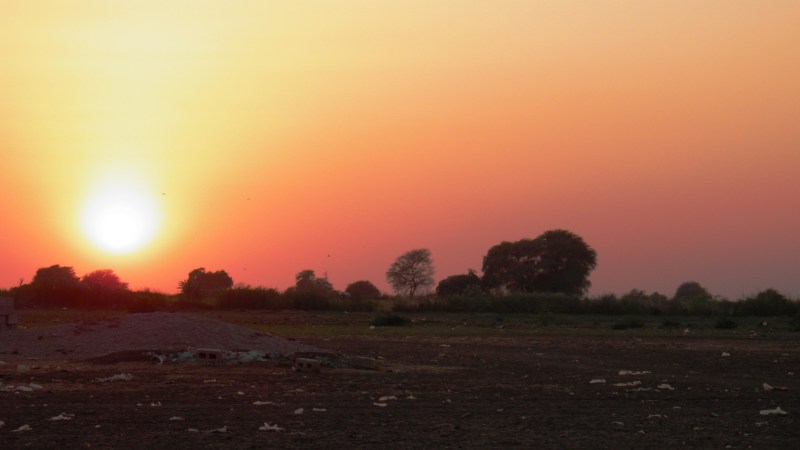
The loss of Nubia for some is no tragedy, no great loss.  Just a set of villages that were standing in the way of progress.  Time will erase the sounds, the smells, the tastes of home.

As we wrapped up and reflected on our visit to New Halfa, the site where my father’s family was resettled, and walked through my father’s house, the question lingered.  Was this home for the Nubians or part of a long, incomplete journey.

Throughout history, Nubians have always made journeys.  Nubian archers were always a part of the ancient Egyptian armies, and more recently British colonial armies.  Nubian fathers have often journeyed to distant cities to earn a living for their families.  But the value of these journeys was always measured by the sweetness of coming home.  Perhaps this entire episode is just another of those journeys, and around the corner will be a forest of the familiar date palms and the silvery water, contrasted with the vast desert and wide sky.

Our history is made by journeys.  Moses had his exodus to the promised land.  The Prophet Mohammed fled Mecca and established Medina as a capital of tolerance.  American settlers had their manifest destiny.  MLK walked to Birmingham, and Selma, and saw the mountaintop.  These were all painful journeys, but fueled by a mission; the idea and hope for a new beginning in a destination that would be called home.

But the journey to New Halfa was different.  There was no will to leave the beloved home, so closely tied to their identities, beliefs, stories, myths, not for hundreds of years but for thousands.  In so many words the elders explain that they are hoping, searching for the cool, clean water of home, and find none and remain parched.  They are weary, understandably. Few understand what it is like to roam the earth in exodus but without a promised land, like itinerant soldiers with no possibility of relief or recuperation, to wander not for forty days and forty nights, but for fifty years.

In the great tradition of jazz music, a composition starts with a recognizable melody, a chord progression and cadence that is well understood and familiar.  Say, Miles Davis with the call and response with the bass at the beginning of So What.  We all recognize these few bars, connect them to some experience in our past; and anticipate the journey to something new.  He then drops an octave and joined by cymbal crash, announcing the start of the journey; the musicians step into the wilderness, drawing from their inner depths passion, anger, whimsy, or indifference as the case may be.  The tension builds as the journey wanders off into changes of chords and moods, silence, virtuoso riffs, or less so.  But in the end, the musicians look up, acknowledge to each other that it is time to bring it home.  They return to a few bars of the melody of the opening.  By returning to the familiar, we comforted and grateful for the journey.

What is home?    Home is not a roof, or walls or even a location. Home is belonging, legitimacy, authenticity, a place to set roots, to leave a trace of one’s existence on the face of this earth.  Home is a place to realize ones dreams and rest one’s soul.  As this generation of Nubians passes from this world to the next, I sense that their souls are not at rest.

At the same time their commitment to the new land is too tenuous.  This land is capable of providing, but this sense that they are in a land not of their own choosing may ultimately seal their fate.  Only by committing to the land will they prosper.  The younger generation appears ready, but it is not clear what it would take, after fifty years, to make this land home.

For the Nubians in the diaspora, the improvisation does not seem to end.  The music goes on and on, pain for some, joy for others, they struggle to return to the original bars, but the notes are gradually forgotten.  What is not clear is if the new song will at all reflect the sound of the water wheel and the birds, the wind flowing through the date palms, the spirit of the river and of Nubia.
Uncategorized

In their own words


2 Comments

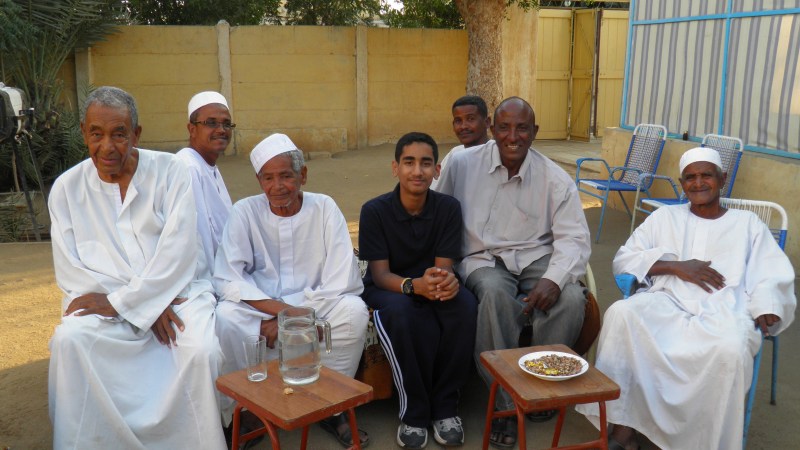
A series of three videos in Arabic filmed in New Halfa.  All are of Nubian elders who are reflecting on their lives since the Hijra.

Ustaz Rushdie, an educator, reflects on his longing for home, and how after fifty years he still dreams of the life he had.

He married in the new country and raised his family.  His children have not seen Old Halfa, yet in his dreams they only appear in the old country.  Nothing in the new land resembles the old, whether the trees, the agriculture, the houses.  Also, old Nubia was isolated from other tribes.  Conflicts may arise from use of land between pastoralists and farmers, which in older times were easily resolved because everyone knew each other.

The land that was provided is larger, but requires mechanized farming and is less productive.  In old Nubia, the plots were smaller but more productive.  He commented on the loss of the language, especially in the towns between the villages.

Abdel Aziz Shelabi talks of being betrayed and fooled by the authorities in 1964, and compensated at a fraction of what was lost in the flood.  He talks about the unrealized plans, and that agriculture worked well initially but that the land has grown tired.  He complains that the project really is for the benefit of others and not the Nubians.

Hassan Abdel Halim talks about the neglect of the village and its infrastructure, including an unfinished road.

Uncategorized

And so it begins …


2 Comments

I woke up this morning in a room overlooking the Nile, a bright, clear day. The water glistens.

My son Tariq is asleep, making evident to me that, among the most important things one loses in 34 years, our difference in age, is the ability to sleep uninterrupted for eight or ten hours straight irrespective of jetlag.

It is the first day of a journey that, for the moment, seems more important to me than to him. We are going to Sudan, the first time for me in five years, and the first time for him in perhaps seven. But we’re going further. We’re are going to explore the villages of my now-deceased grandparents and ancestors in Nubia.

Fifty years ago, two years before I was born, the last trains left the villages in Nubia for New Halfa, leaving behind a civilization, a way of life, and a land that sustained a people continuously for seven thousand years.  This emigration, called al Hijra by the Nubians, resulted from the inundation of the homeland of the Nubians by Lake Nasser and the Aswan High Dam. All said, 50,000 Nubians were resettled on the Sudanese side of the border and 70,000 on the Egyptians side.  I have never set foot in Nubia, yet I feel compelled to make this journey, and make sure my son is with me.

Perhaps because Nubians come from Upper Egypt, which is among its poorest regions, perhaps because of their darker complexion, or perhaps because of the traditional role that many Nubian men have played as doormen or servants in the palaces of Ottoman Pashas, the Nubians, in the popular imagination, often seen as simple country folk by the cosmopolitan Cairo or Alexandria crowd.

As a result, Nubia is not understood as a source of civilization, a cradle of history, but as the end of the road – a road on which played out an enlightened Mediterranean civilization of Pharaohs and Moses, Hyksos and Assyrians, Romans and Greeks, Turks and Brits, an Elizabeth Taylor-like Cleopatra and Richard Burton-like Anthony. At the end of this cul-de-sac, in the popular imagination, there is a Nubian house where country folk live, beyond which is a barren landscape, wilderness, primitive darkness and Africa.

But the stones tell a different story. The history of this region is long, and the relationship between Nubia and Cairo has ebbed and flowed like the Nile that glistens below. In Nubia has existed poverty but also fabulous wealth, simple rural lives, and the seats of complex empires. In fact civilization flowed in both directions; Nubia was not a cul-de-sac but an intersection of cultures, trade and ideas.

Nubia’s place in history has been chronicled in the Old Testament, the writings of the Greeks including Homer, Diodorus, and Flavius, in the stones and the clay artifacts unearthed by archeologists. As early as 13,000 BC, organized social structures and a complex civilization emerged, supported by a cattle-based economy, with strikingly modern-looking clay pottery the world’s first cemeteries an unmatched ritual devotion to their gods and kings.

By 3,000 BC, society flourished, and traded with distant lands.  As early as the sixth dynasty (2,300-2,400 BC) there were diplomatic, cultural and economic relations between the capital of Nubia, Kerma, and the capital of ancient Egyptian, called Memphis (near Cairo). Ancient Egypt and Kush vied for supremacy for millennia; Kush grew more powerful when Egypt was weakened by invaders from the north; Kush in turn grew weaker through its conflicts with neighbors to the south.

Around 750 BC the Nubians were in the ascendancy, and finally conquered the Nile Valley in which is now called the 25th and 26th dynasties. The Nubian Pharoahs, starting with Piankhy, revived the religious traditions and culture of the Nile Valley and extended Nubian power from Khartoum to the Delta. In fact, the Nubian Pharaohs projected power beyond their borders; it was a battle in support of the Jewish kings of Jerusalem against the Assyrians that ultimately brought down the dynasties.

It is difficult to imagine today. History ended 50 years ago, before we could fill in the details. The better part of Nubia was submerged by the Aswan High Dam.

To discover the truth – the source of the dignity, piety and humility that courses through Nubian blood – requires a journey. As John Garang said at the outset of his speech at the end of Africa’s longest civil war, understanding Sudan requires us to first withdraw, to step back, as a tsunami first withdraws and gathered strength before issuing forth in its full fury. This is our moment of quiet.

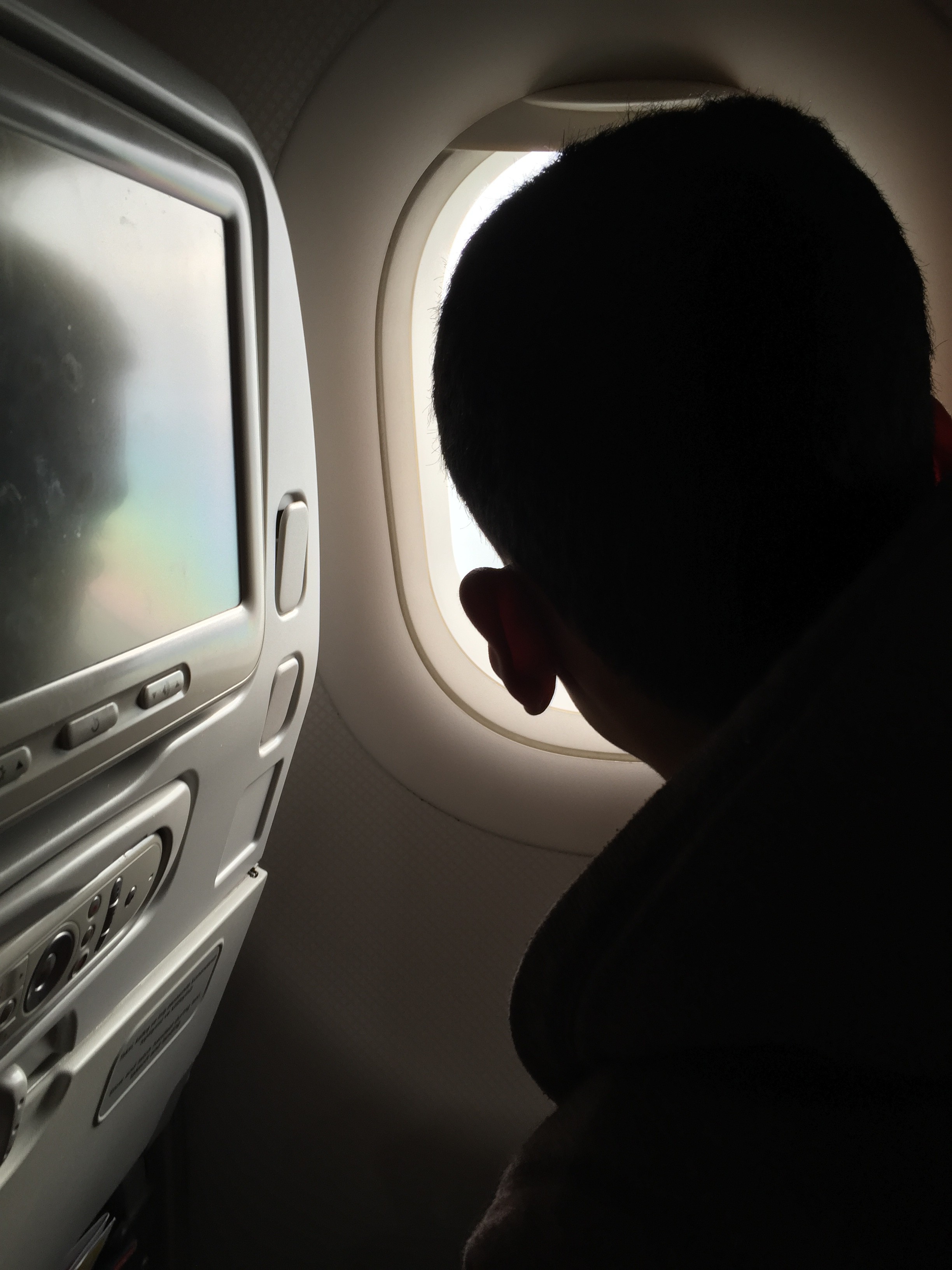
The plane takes off and we lift into a dusty Cairo sky, as if into a “Haboob” dust cloud rather than the low atmosphere of a normal day. There are in fact no clouds, but visibility is limited by the winter haze of Cairo, a mixture of burning agricultural waste, pollution and dust from the teeming masses below.

The glaring sun through the window fades into an angry red-orange line across the horizon, splitting the vast grey desert and the deep cobalt sky, in which one star and a crescent moon stand watch. On the other side, a British-Sudanese family makes its way back home with heavy London accents.

Anticipation

Two hours later, we start our descent.