Arrival in Khartoum was unexpectedly pleasant. The weather in December is cool, and my cousin Wagdi and his son arranged a nice arrival and put us up in a new apartment at his mother’s house. From one of the important Nubian families, he treated us in an extremely generous and kind way throughout the trip.
On our first day in Khartoum we visited relatives. Visiting is a time-honored tradition; almost an art form. It can be entertaining, especially with someone with a good sense of humor. Visits reinforce the social network, which is built around the large extended family, by spreading news about weddings, births, graduations, illnesses or deaths, and general well-being of the whole family. The visits help maintain friendships over generations. An aunt in Port Sudan, far from our route, asked us to visit. She grew emotional when she found out that this was not possible, explaining through her tears that my visit would be like a visit from my father, who she dearly missed.
As a sign of hospitality, one is offered a sweet and a glass of cool water at the start of the visit. One might be offered tea, one of the Sudan’s traditional drinks, made from hibiscus flower or baobab, or mango, grapefruit or guava juice. Sudan has the best of these, despite what Indians or Filipinos may tell you about their mangoes. Greetings ensue, which include blessings of various types, checking on the well-being and news about brothers, sisters, cousins and their children. There may be two rounds of greetings. Then conversation begins, sharing perspectives on the US, and we learn about Sudan.
However important, Tariq was dead tired of these visits by nightfall.
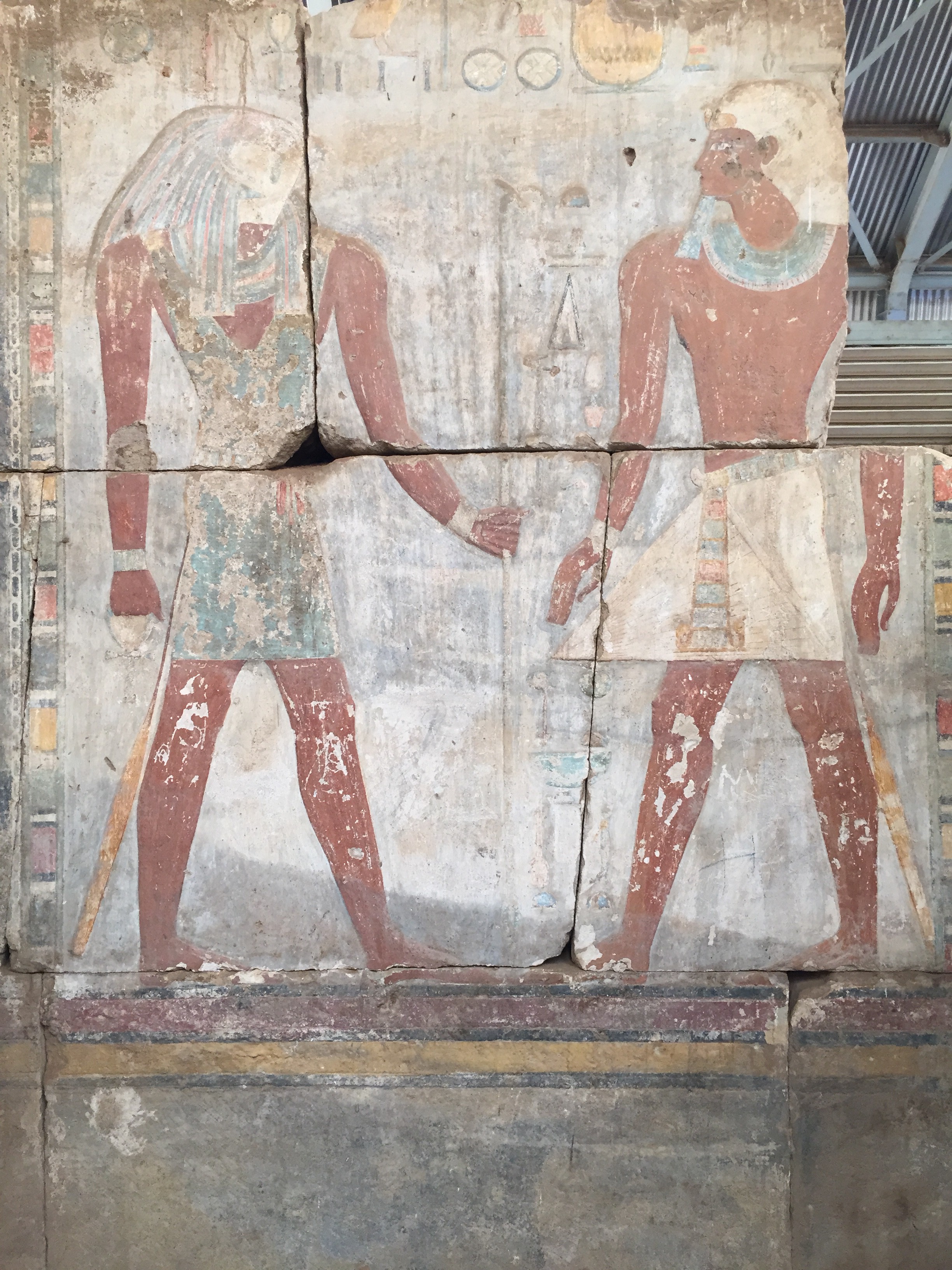
In the morning we visited the national Museum. The entrance fee was two pounds each, something like 30 cents. The museum contains colossal statues of the great Nubian Pharoah Taharqa, who unfortunately lost the empire by taking on the Assyrians in support of Jerusalem. Nubian jewelry, paintings from the Christian temples, and Kerma pottery that would make any artist proud are on display. But what we came to see were the Buhen and Semna temples, built by Queen Hatshepsut and Pharaoh Thutmose III, that were removed from Nubia at the time of flood, and rebuilt in the garden of the museum. Tariq and I were able to walk through, and enjoy walls full of hieroglyphics, some still painted in their original colors.
Supervision was lax. Similar temples at the Louvre or the Metropolitan Museum in New York are behind glass. Here, nothing prevents you from touching the raised hieroglyphics, 3,500 years old, bearing the original paint. It is painful to see the carved inscriptions of Turkish, Greek and British soldiers who left their marks in the 1800s, and modern visitors who leave their marks in Arabic, English and Chinese.


We then visited what Tariq used to call the “egg building” while it was under construction, a modern building in the shape of a sail. Now the Corinthia hotel, we went up to the 18th floor and got a panoramic view of Khartoum. He had a thick mango juice and I had a spicy Sudanese coffee in a traditional clay pot.
I have mixed views on this building. When it was started the only large hotel was an ex-Hilton, with seven star rates and a three-star facility. Something better was needed. Col. Ghaddafi of Libya decided to finance a hotel costing around $100 million! The government removed the national zoo to make way for it.
It was developed in a moment of euphoria in the wake of the Comprehensive Peace Agreement with Southern Sudan, and a partial agreement in Darfur. I would have appreciated this hotel more if Libya had diverted some funds in parallel to projects, such as livestock exports, water or electricity that might have created jobs, better lives, hope, and a greater chance that the peace would have been sustained. The euphoria and the peace didn’t survive. Neither did Ghaddafi.
The next morning, after the dawn prayers we set out to visit New Halfa, where the Sudanese Nubians living in the flood zone were resettled.
The sun rises, the crowds are already at the various bus stops. We pass by factories, auto dealerships, markets, and more bus stops. Gradually, the sights of the city give way to the scenes of the countryside. Three girls walk chatting, each with a dark dress and different colored headscarf. An old sheik stands by the side of the road, his arms crossed, waiting. A soldier tries to hitch a ride. The bus fills up, slowing down traffic, we pass. Across a field a boy rides on a cart pulled by a horse, it tosses its head and gallops along.
We pass a village called Kamleen, another called or “Heesa Heesa”. Three ladies cross the road, each carrying firewood. Five hours pass in similar scenes.
Mesquite trees line the horizon. Introduced by German donors who spread the seeds to combat desertification, the trees spread quickly and now the government has spent millions to eradicate this tree. As we get closer, Gum Arabic trees line the road. Native to Sudan, the trees provide income to poor farmers, fodder for animals, and improve the soil. Sometimes we need to appreciate local solutions.
The mud brick houses look tenuous, as if the next big rain might take them away. We turn off the main highway around Kassala, and approach New Halfa.
A shepherd guides a bull toward some pasture, a herd of cows follow. A group of boys Tariq’s age swims in the irrigation canal, laughing, and another warms himself sprawled out on the black asphalt, until the last second, when he springs up away from incoming traffic.

The land is green, irrigated farms on either side. A donkey stands in the middle of the road, undecided.
It is said that when the Nubians were resettled, they found a large herd of donkeys milling about in the agricultural area. The British had used them in World War II in mine clearing operations against the Italians and then set them free. They multiplied. Each Nubian family took one to use to help cultivate their plots.
A pool of irrigation water to the side of the road, and a flock of white herons drinks. The land area is simply massive, there is flat earth in all directions as far as the eye can see.
The outlines of the standardized housing built for the Nubian migrants start to appear.
We’re approaching New Halfa, the resettlement area that the government chose against the will of the Nubians fifty years ago.


 After the flood
Well done, enjoyed reading your blog. Have a safe journey and look forward to hearing more about your adventures.
LikeLike